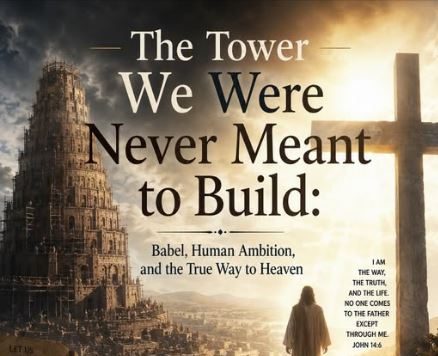
The account of Babel is often remembered as the story of humanity’s languages being confused and scattered across the earth. Yet beneath the surface lies a profound theological lesson about human nature, divine authority, and the only legitimate path into the presence of God.
The narrative appears shortly after the Flood, when humanity was given a clear mandate. God had instructed Noah and his descendants to be fruitful, multiply, and fill the earth. The nations were intended to spread outward, stewarding creation under God’s authority. Instead, the people gathered together in one place and determined to establish a monument to themselves. Their words reveal the condition of their hearts: “Let us make a name for ourselves, lest we be scattered over the face of the whole earth.”
At first glance, the construction project may seem harmless. Cities are not inherently evil, nor is architecture. The problem was never the bricks. The problem was the rebellion.
Babel represented humanity’s collective attempt to achieve unity, security, and exaltation apart from God. Rather than receiving identity from their Creator, they sought to create their own identity. Rather than submitting to God’s command to disperse, they sought to remain together on their own terms. Rather than glorifying the name of God, they sought to establish their own name.
The tower itself was likely patterned after the stepped temple towers common in the ancient Near East. These structures were designed as sacred mountains, places where heaven and earth supposedly met. In essence, Babel was humanity’s declaration that it would establish its own access point to the divine realm.
This is where the account becomes deeply relevant to every generation.
The spirit of Babel has never disappeared. Humanity continues to seek heaven through its own achievements. Some seek it through religion. Others through philosophy, morality, political systems, technological advancement, wealth, or personal enlightenment. The methods change, but the impulse remains the same. Fallen humanity continually attempts to bridge the gap between earth and heaven through its own efforts.
Babel was not merely a building project; it was a theological statement.
It proclaimed that mankind could ascend.
Scripture consistently teaches the opposite. The problem of humanity is not that we lack a ladder tall enough to reach God. The problem is that sin has created a separation that no human effort can overcome. No tower can be built high enough. No system can be developed sophisticated enough. No religious observance can be perfected sufficiently.
The distance between a holy God and fallen humanity cannot be crossed from below.
The irony of the Babel narrative is striking. The builders imagined themselves constructing a tower that reached the heavens, yet the text humorously states that God “came down” to see the city and tower. What appeared immense from a human perspective was insignificant from the divine perspective.
Human pride always overestimates itself.
The builders believed they were ascending toward God, but God had to descend simply to observe their accomplishment.
This theme echoes throughout Scripture. Again and again, mankind attempts to rise, while God demonstrates that salvation comes through His descent.
The ultimate answer to Babel is found not in another tower but in a Mediator.
Where Babel represents humanity reaching upward, the Gospel reveals heaven reaching downward.
Yeshua did not teach humanity how to build a better tower. He became the bridge that humanity could never construct. He did not offer another path of self-improvement or spiritual ascent. He declared Himself to be the way.
This is why the imagery surrounding Yeshua is so significant. In the vision given to Jacob, a ladder connected heaven and earth, with divine activity moving between the two realms. Later, Yeshua identifies Himself as the fulfillment of that reality. He is the meeting place of heaven and earth. He is the point of connection between God and mankind.
Babel sought to create an artificial gateway to heaven.
Yeshua is the gateway provided by heaven.
Babel was founded upon human pride.
Yeshua demonstrated perfect humility.
Babel attempted to glorify humanity.
Yeshua glorified the Father.
Babel sought unity through human power.
Yeshua creates unity through redemption.
Even the scattering at Babel points toward a greater redemptive purpose. Humanity was divided into languages and nations, but God’s plan was never abandoned. Throughout Scripture, He works toward the restoration of people from every tribe, tongue, and nation. The division introduced at Babel is ultimately answered through the Kingdom of God, where people from all nations are gathered under the lordship of Messiah.
The contrast is profound. Babel sought unity without submission to God. The Kingdom creates unity through submission to God.
One is built on human ambition.
The other is built on divine grace.
The lesson for believers is both simple and challenging. We must constantly examine whether we are building towers or following the Mediator. Religious activity itself can become a form of Babel if it is driven by self-exaltation. Ministry can become a tower. Knowledge can become a tower. Reputation can become a tower. Even good works can become a tower if they are used as a means of establishing our own significance before God.
The Kingdom does not advance through human monuments. It advances through faithful dependence upon the One who has already accomplished what we could never achieve.
The builders of Babel looked upward and asked, “How can we reach heaven?”
The Gospel declares that heaven has already reached down to us.
The answer was never a tower.
The answer was always the Mediator.
Humanity’s greatest error was believing that access to God could be constructed by human hands. The greatest truth of Scripture is that God Himself provided the way. Every brick of Babel testified to human effort. Every aspect of the Gospel testifies to divine mercy.
The tower stands as an enduring warning to all generations. Whenever humanity attempts to ascend through its own wisdom, strength, religion, or achievement, it is repeating the mistake of Shinar. But whenever a person humbly trusts in the Messiah whom God has sent, they discover the reality that Babel could never produce: genuine reconciliation between heaven and earth.
The way to heaven is not built from the ground up.
It comes from above. Through Yeshua, the Mediator between God and man, heaven and earth are brought together exactly as God intended.
Leave a Reply