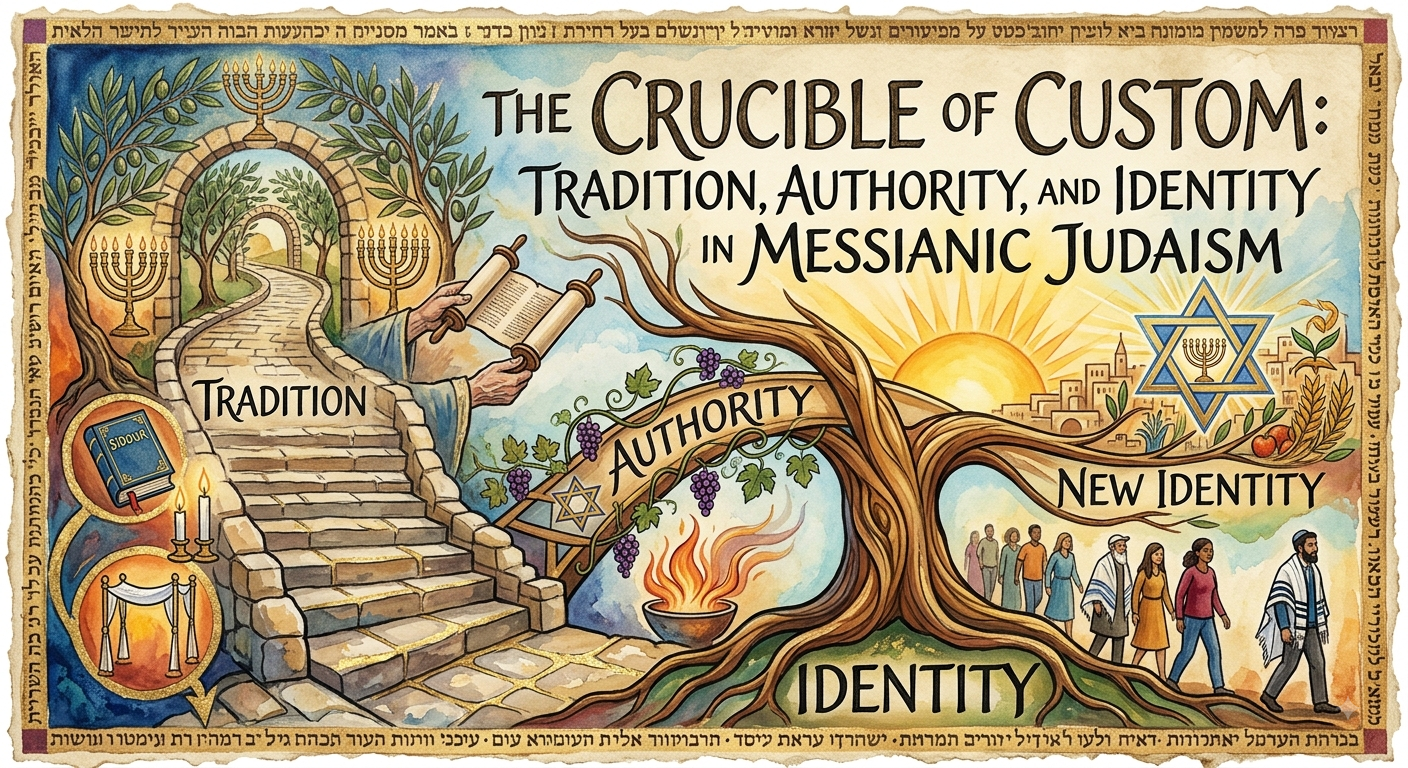
Every religious tradition must eventually answer a fundamental question: where does divine revelation end, and where does human stewardship begin? Within Judaism, this interplay between the Written Torah (Torah Shebichtav) and the Oral Torah (Torah Shebe’al Peh) has anchored communal life, liturgy, and legal interpretation for millennia. For Messianic Judaism, however, the question carries a distinct theological urgency. In navigating the space between ancient rabbinic heritage and faith in Yeshua of Nazareth, the movement must continually define the purpose, boundary, and authority of Jewish tradition (masorah).
The central tension does not lie in a rejection of tradition, but in its theological calibration. Rabbinic tradition provides the rhythm of Jewish life—the architecture of the prayer book (Siddur), the melodies of the festivals, the sanctity of the lifecycle events, and the communal standards of holiness. Yet, the New Testament texts present a complex dialogue regarding human custom. When Yeshua addressed the “traditions of the elders” in Matthew 15 and Mark 7, the critique was not directed at ancestral observance itself, but at the elevation of human fence-building above divine commandments. The challenge for Messianic thought is discerning between traditions that protect covenantal faithfulness and customs that obscure the primary intent of Scripture.
Across the movement, this dynamic produces three primary approaches to rabbinic custom:
Covenantal Continuity and Messianic Halakha: This perspective views rabbinic tradition as the authentic, historically continuous language of the Jewish people. Proponents argue that the early believers in Jerusalem were thoroughly observant within the Second Temple framework, actively participating in Temple rites and Jewish communal life (Acts 21:20–24). Here, traditional observances—such as liturgical prayers, kosher standards, and festival rituals—are embraced not out of legalism, but as a living expression of covenantal identity, re-examined and renewed through the authority of the Messiah.
Biblical Primacy: Other streams adopt a more conservative boundary, maintaining that divine obligation resides strictly within the written biblical text. In this view, rabbinic customs and Talmudic expansions are regarded as valuable cultural heritage or practical tools, but lack binding authority. Traditions are honored so long as they align with the written Word, but discarded or simplified whenever they threaten to add unnecessary burdens to faith.
Symbolic and Prophetic Renewal: A third approach treats traditional customs as profound pedagogical instruments. Traditional elements of the Passover Seder, the imagery of the Fall Feasts, or the symbols of the Sabbath table are interpreted primarily through their prophetic resonance, serving as vivid illustrations of redemption and Messianic fulfillment.
This theological wrestling is not merely theoretical; it directly shapes everyday communal life. In liturgy, congregations often preserve the traditional structure of the Amidah and the Shema, blending ancient prayers with explicit affirmations of Yeshua’s messiahship. In festival observances, biblical commands are enriched by historical customs—such as the lighting of the Hanukkah menorah or the reading of the Haggadah—while rooting their ultimate meaning in the character and work of God.
Ultimately, the Messianic view of tradition seeks neither wholesale abandonment nor uncritical adoption. Instead, it engages in an ongoing dialogue between continuity and reform. Tradition is recognized as the vessel that has carried Jewish memory across generations of exile, while the authority of Scripture remains the compass by which every human tradition is weighed, tested, and redeemed.
Leave a Reply